

What is the typical Process installing a pool?
1. We welcome you to inspect our pool range at our premises at Lansdale and ask that you bring your house plans. Here you will be given the prices of our pools including installation costs.
2. We then come to your home to do a site inspection and confirm the price given and measure up pool location as well as machinery access. Equipment location is decided on and therefore the location ofthe power points needed. Working out the cheapest way of craning or lifting the pool into the hole is done on this visit. You then sign a building application form required by the council and give us a copy of your site plans.
3. WA Plunge Pools will then submit all relevant paperwork to your council and Watercorp via our building surveyors for their tick of approval. Once we have approval – which is usually 2 weeks we schedule your install for a time convenient to you.
4. On install day we arrive at 7.30 am. 2-3 hrs later the pool is getting lowered in the hole. We start backfilling and filling the pool with water followed by equipment connection. Usually we are finished by 3pm. Sand removal is included in the price providing it is clean fill. On install day a compliant temp fence will be placed around the pool.
5. A day or two after the install we organise the Pencil Compaction followed by the handover. It includes instruction on cleaning your pool, testing/balancing the water and equipment know how. You can then confidently look after your new pool and if ever you are in doubt we encourage you to ring us with any questions. We also balance the water for you and soon after this the pool is ready to be swum in – typically its hard to keep the kids out once we’ve done the handover.
How close to the boundary can we go and what size pool will fit in my area?
The general rule of thumb is that a pool must be whatever its depth measurement is – away from anything structural (house, pillars, brick wall, retaining wall) or a boundary to be compliant. So in other words a 1.5m deep pool should be 1.5m away from the boundary. However this distance can be shortened due to the nature of pools tapering in as the side walls reach the floor.
The 625 Plunge is a perfect example whereby the depth is 1.5m but we can go as close as 1.2m without engineer certification due to it tapering in at the floor (i.e. the walls angle inwards). Its all about the ‘angle of repose’ or simply put having an excavation at 45 degrees from the bottom of the hole to the top without interference.
The Bali Plunge has vertical straight walls and because of this requires 1.6m (its depth) distance. At the step end we can be 900mm from a structure simply by following the laws of the angle of repose, ie 45 degrees from bottom of excavation. Any less than this and we require engineer certification.
Every pool model, according to its depth and shape has limits on how close to it can be installed to boundaries and structures according to its engineer certified drawings. With added engineer certification pools can be installed closer than their depth but if deemed necessary and in most cases the engineer will request chemical injection or pilings be done before excavation. Ideally we try and position steps, benches and shallow ends were they are more beneficial to avoiding added engineer and injection costs.
As installers of pools we prefer an area that allows room for backfill to be placed around the edge of all sides of the dig as well as room for the digger to perform a complete dig however with todays smaller blocks this isn’t always achievable.
Do I require an Engineer’s Certificate?
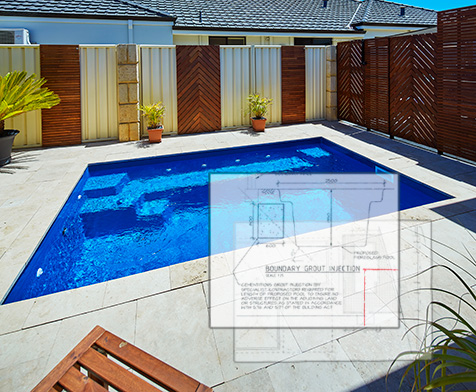
With engineer certification we can go closer than the prescribed measurements, however if we need to go too close then grout/chemical injection is required. This is where a liquid cement of sorts is pumped under the footings, wall or pillar to a required depth that then hardens and creates a soil that will create a safe work environment and stabilise any load bearing surcharge. If the customer has footings to depth under a pillar or structure then this negates the need for injection.
Cementitious grout injection is vitally important on large retaining walls and two story houses where the excavation gets close. Not so necessary when digging near a Colourbond fence where the neighbour is at the same level.
Will I require cementious injection?
With engineer certification we can go closer than the prescribed measurements, however if we need to go too close then grout/chemical injection is required. This is where a liquid cement of sorts is pumped under the footings, wall or pillar to a required depth that then hardens and creates a soil that will create a safe work environment and stabilise any load bearing surcharge. If the customer has footings to depth under a pillar or structure then this negates the need for injection. Cementitious grout injection is vitally important on large retaining walls and two story houses where the excavation gets close. Not so necessary when digging near a Colorbond fence where the neighbour is at the same level.
Can I install near a shared Colorbond fence?
Certain leniency is allowable providing the neighbour hasn’t got anything built close by. Surcharge from driveways or potential new buildings has to be considered though when installing next to a boundary. Often we have to do what’s known as a modified backfill where cement dust is added to the backfill soil.
A common example would be a customer wanting to go 400mm off a boundary. With an edge beam of 200mm and the need for a 100mm gap so we can backfill the hole, that only leaves 100mm from excavation to the fence line. This is were we prefer to be at least 500mm from waterline to boundary.
The options on a Colorbond or light duty fence would be to shore up the hole as we dig (see diagram), take the fence down and re-erect or commonly see how we go on the day within reason according to soil type. If the boundary was a brick wall or had retaining then it would need chemical injection.
What inclusions come standard with every pool installation?
1. Swimming pool with skimmer box and 2 jet returns.
2. Astral 1hp pump/motor (3 year warranty)
3. Astral zx series cartridge filter, 100 sq ft or 150 sq ft (5 year tank warranty)
4. Astral E25 self cleaning salt chlorinator with timeclock (3 year warranty cell and box)
5. Astral multi colour LED pool light (1 year warranty)
6. 500 micron solar blanket/ pool cover
7. Handover kit/ cleaning kit
8. Installation of pool including sand removal and equipment connection (standard access, level sandy site – added cost if limestone encountered)
9. Delivery of pool within metro area
10. Crane to 32 mts
11. Council and Watercorp approvals
12. Full handover / demonstration of pool and equip including water balance at completion

